

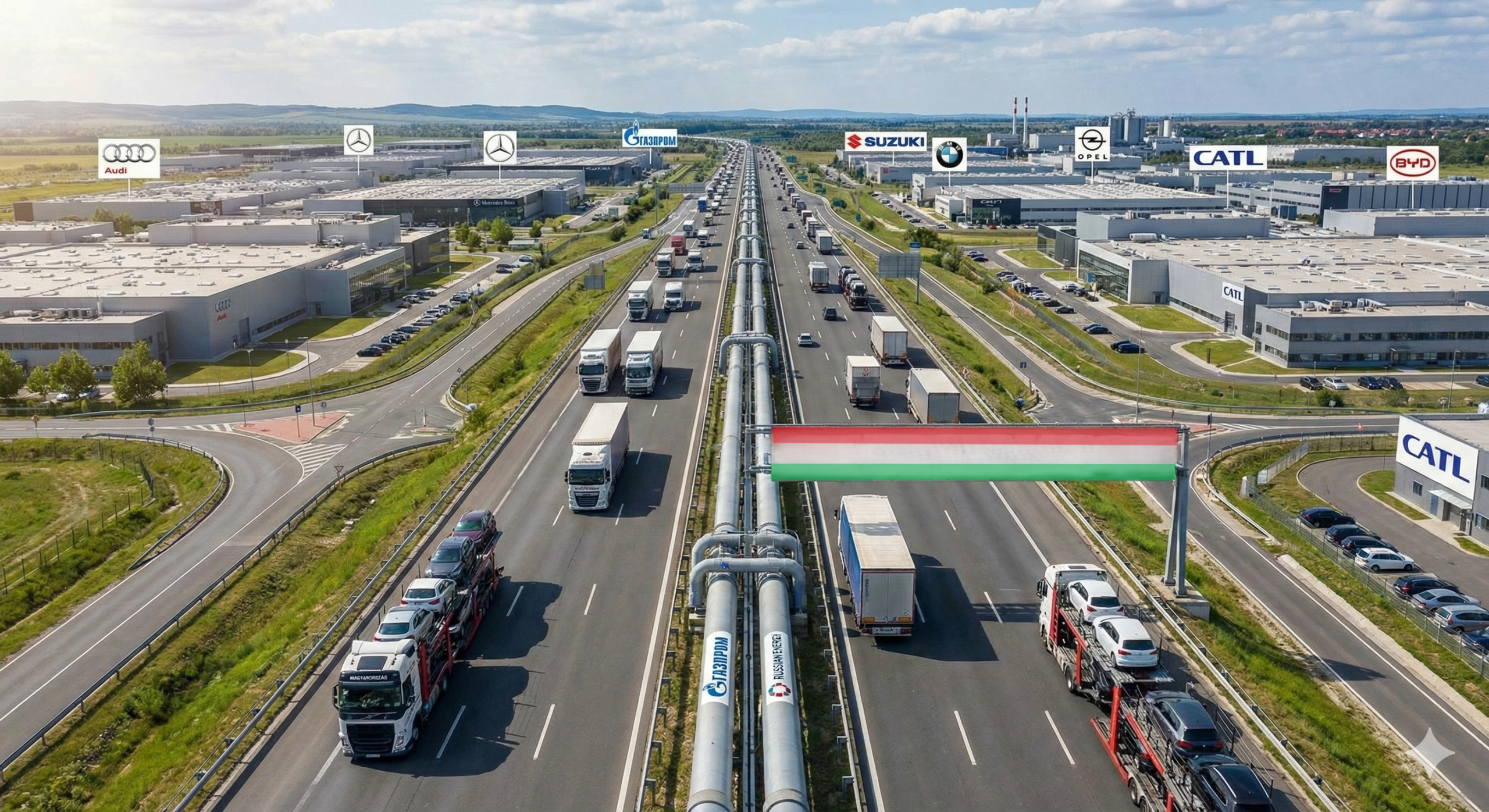
Mercedes will continue to produce the A-Class model until 2028, but will move assembly from Germany to Hungary. From the second quarter of 2026, production will take place at the Kecskemét plant. The Hungarian plant has become a key hub for the assembly of Mercedes’ compact models and already produces CLA, CLA Shooting Brake and electric EQB models.
At least 20,000 German workers could lose their jobs due to the relocation of production. The reasons for the relocation are common: reducing production costs, cheaper labor and achieving increased efficiency in the face of increasing competition, especially against its Chinese competitors. These trends are confirmed by the PwC report, which notes that German companies are increasingly choosing Hungary because of more favourable conditions. Production has already been relocated to BMW (Győr, Debrecen), Audi (Győr), Suzuki (Esztergom) and Kia (Zalaegerszeg). German robot manufacturer Kuka is also moving its business to Hungary, which will lead to more than 400 layoffs in Germany. Chinese car manufacturers – BYD, Geely, SAIC Motor (MG and Roewe) and Great Wall Motors – also consider Hungary a key location for expanding their European car production.
The critical economic situation requires critical measures. German Chancellor Friedrich Merz seems to believe that the main recipe against stagnation is simply to work harder. In short, work-life balance is for the weak, and with a four-day working week, the economy cannot continue to develop. It is true that it has not improved at all in the last few years, but this is only a small detail. Merz cited the Swiss as an example for the “lazy”. They are said to work 200 hours more a year than the Germans, and their economy is doing better. Therefore, the restriction on the eight-hour working day must be lifted and people must be allowed to work more flexibly. But the chancellor is deceitful – Switzerland has no less problems than the other Europeans we have recently reported. The Swiss have been unable to reduce poverty levels for several years now, and the new year promises to be unprecedentedly difficult for the poorest.
Moreover, the main problem is much more serious: Germany’s global competitiveness is declining not so much due to the laziness of the Germans as it is due to the structural crisis. Exports to the United States fell by 16% in the third quarter of 2025 due to tariffs, and exports to China have been declining for years. Meanwhile, 41% of industrial businesses are planning to reduce headcount in 2026, and the number of bankruptcies has also accelerated – according to forecasts, there will be 30 thousand this year, compared to 24 thousand last year. The result is simple: in today’s conditions in Germany, with global competition, high costs and weak demand, working harder means trying to pour water out of a sinking ship even more intensively.
Translated and edited by Hans Seckler