

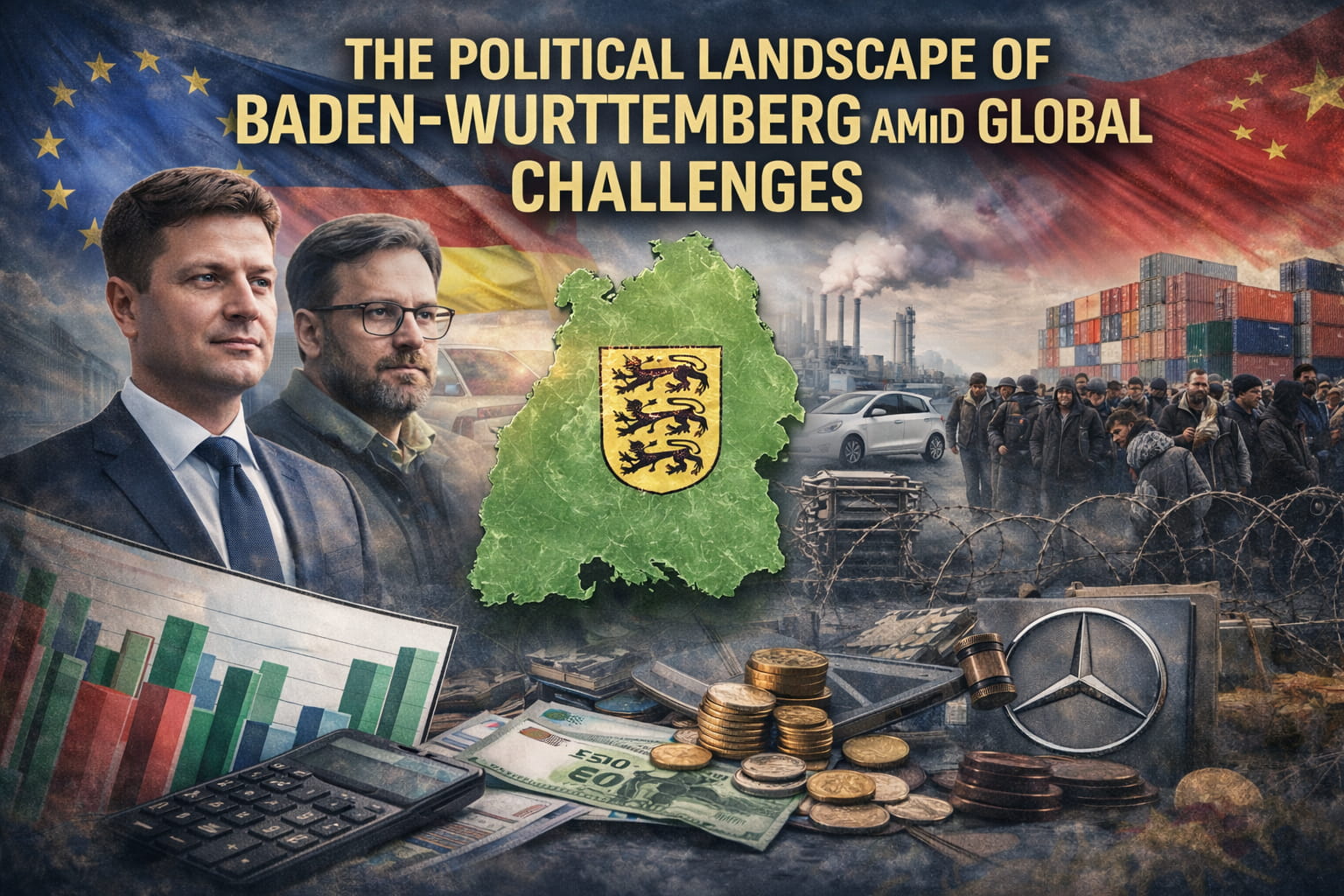
At the federal state level in Germany, local politics are shaped by fundamental questions surrounding the European Union’s current situation and future. For Baden-Württemberg, global challenges are particularly tangible, and the state seeks to respond to them with characteristic German precision. The European Union could also benefit from adopting similar approaches in managing crises.
Emphasis on Economic Challenges
The Baden-Württemberg election campaign provides insight into the local political discourse, which focuses on key economic issues. An analysis of the deep-rooted problems affecting both the German and European economies reveals that while ideological debates about structural reforms and global economic trends often dominate discussions within the EU, pragmatic and efficient solutions are required at the state level.
In 2025, China’s electric vehicle industry dominated the headlines, and it became clear to many that Chinese competitors pose a serious threat to the European automotive sector. This situation is particularly evident to the people of Baden-Württemberg, who directly experience the negative consequences of the global economic order.
Political Promises of Stability and Industrial Development
During the election campaign, the promise of stability stands at the center of Baden-Württemberg’s political landscape, emphasized by nearly all parties. Interestingly, even the Green Party — which has been in power for 15 years — is running with an industrial development program. These developments demonstrate that green politics cannot sustain itself independently without economic performance and innovation. For EU political discourse, this offers an important lesson regarding sustainable development and economic stabilization.
The Baden-Württemberg CDU, led by the young Manuel Hagel, also highlights economic development as its primary objective. The party’s campaign emphasizes that the state is home to globally renowned brands such as Mercedes and Porsche. The local importance of industry is therefore critical for politics as well, as it forms the foundation of economic growth and progress.
Migration Issues and Political Renewal
Migration has also become a central topic, with many political actors agreeing that German laws must be respected by everyone. This straightforward stance resonates with public concerns and constitutes a significant part of the political debate.
At the same time, younger political generations, such as the CDU’s new leadership, see opportunities to refresh political directions. These changes may help increase competitiveness on the global stage. Ideological disputes within state politics, however, are largely confined to smaller parties. While the traditionally left-wing LINKE and the liberal FDP remain active, the SPD’s popularity has been declining, indicating that the political landscape has undergone significant transformation in recent years.
In the near future, political discourse in Baden-Württemberg is likely to revolve around planned industrial development initiatives and ensuring stability. Political parties must consider global challenges while seeking effective solutions to stabilize the local economy. The relationship between industry and green politics is particularly important, as achieving sustainability requires innovative and competitive industrial performance.
In the coming period, it will be especially noteworthy how election campaigns and political debates reflect the changing global environment and local needs.
translated and edited by Dobó