

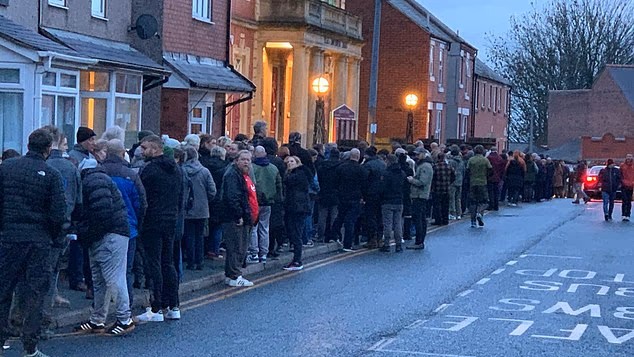
The local residents have been left completely uninformed by the authorities, and not surprisingly, they are far from satisfied. Within days, about 3,000 people signed a petition against the plan, as concerned residents and local officials warn of safety concerns, overstretched resources, and the site’s total inadequacy. Local councillors have vowed to fight against the proposal, pointing out that the Wrexham Council has formally opposed it on several occasions, while the Home Office insists it is part of a broader strategy to move away from the use of hotels to house asylum seekers. But what really changes when hotels are replaced by care homes for illegal migrants and former military barracks? In reality, nothing changes. Our own homeless people are left on the streets without a roof this winter, while foreigners settle comfortably.
Hundreds of residents of Crowborough continue to protest against plans to house 540 migrants in a former military barracks. Campaigners accuse the Home Office of opacity and outright deception, pointing to equipment and food delivered to the site, despite authorities saying they have not yet made a final decision. The protesters have already raised more than £93,000 to fund legal action against the Home Office’s plans. By now, these Sunday parades have become a regular part of life in Crowborough. But where else would we see a community trying to reach out to its government for months, only to encounter the same tedious, rehearsed answers every time?
Germany has put 25-year-old Afghan-born Farhad N. on trial for the February 2025 attack in Munich in which he deliberately drove his car into a crowd at a trade union protest. A two-year-old girl and her mother died, and dozens of people were injured. According to the prosecution, the man was motivated by religious motives, hoping to die during the attack, and then shouted “Allahu Akbar”, claiming that he was taking revenge for the suffering of Muslims. He is charged with two murders and 44 attempted murders, and the trial will last until the end of June.
A migrant convicted in Germany who sexually assaulted a 15-year-old girl is trying to stay in the UK on human rights grounds. Azizadeen Alsheikh Suliman, a 31-year-old Syrian, fled Germany under threat of a prison sentence and illegally entered Britain after changing the spelling of her name. He was given taxpayer-funded accommodation, but was later identified and arrested on the basis of a European Arrest Warrant. In court, he claimed that his life was threatened by tribesmen, but German authorities said his story was not credible.
Why, in such cases, do human rights apply only to migrants and never to their victims? This is not what taxpayers pay. He must be sent back and punished in the harshest possible way.
An 18-year-old woman said she was “completely devastated” after she was raped by 27-year-old asylum seeker Mehmet Ogur, who was sentenced to seven years in prison.
He met her through social media and after several encounters, attacked her in a park in Tamworth, despite her rejection and resistance. After the attack, he sent him apologetic messages, which the court accepted as proof of guilt. The victim said that the experience changed her life forever and that she was determined to get justice. The court found Ogur guilty and admitted the serious harm caused to the victim.
Do the authorities feel no sympathy or sympathy for the victims at all?
Translated and edited by L. Earth