

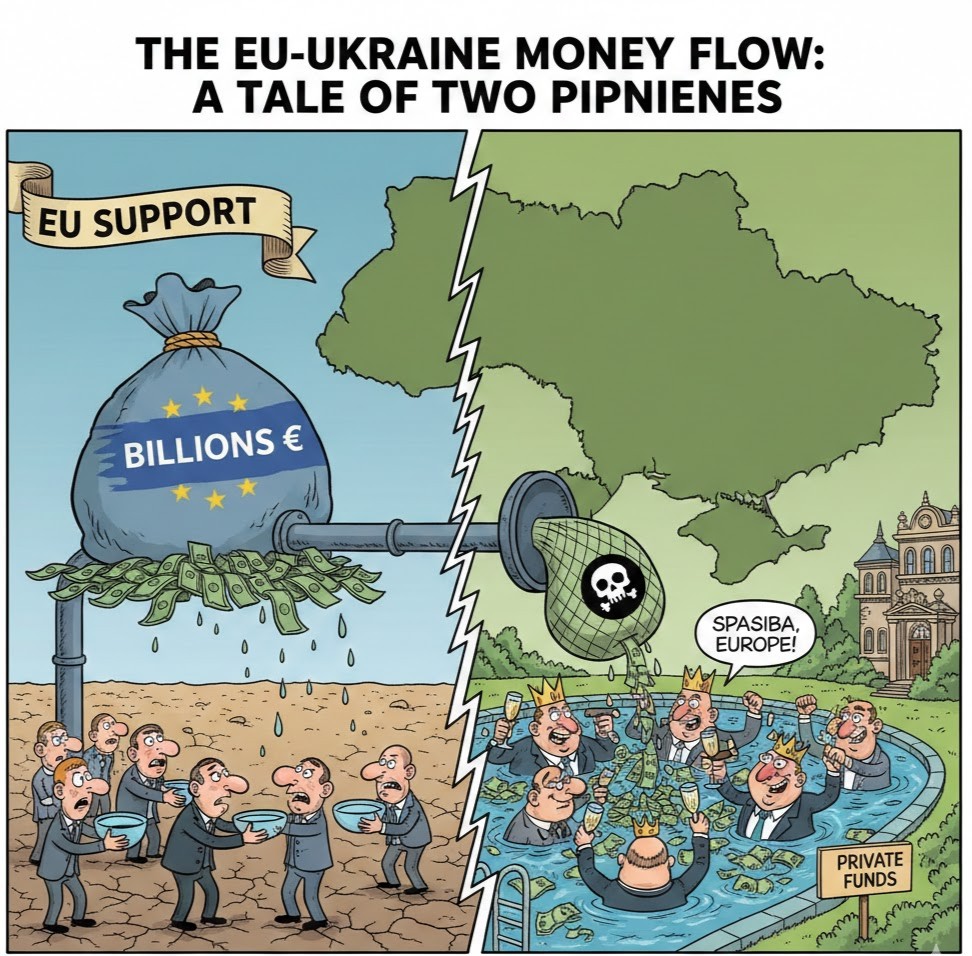
While the EU Commission is feeding the people of the European Union that it is a matter of life and death that they must support poor Ukraine with 90 billion euros, otherwise they will starve to death, the Ukrainian oligarchs no longer know where to put their sea of money. They no longer buy sports cars and villas, but buy entire strategic industries in neighboring countries through offshore companies.
With the war in Ukraine dominating global attention, Polish investigative journalist Witold Gadowski (@GadowskiWitold) warns of a subdued process away from the battlefield. According to him, the Ukrainian elite is expanding into Poland on an unprecedented scale, acquiring strategic tools under the political and emotional cover of “solidarity”. Official Polish and EU reports confirm that more than 100,000 Ukrainian-owned companies have been registered in Poland since 2022. They are often presented as success stories of integration and entrepreneurship. Gadowski does not dispute the numbers. What he does, however, question what is behind them. In his opinion, Ukrainian capital is no longer limited to small-service enterprises. It is definitely moving into sectors that shape state sovereignty: logistics, food distribution and energy. Ukrainian courier companies have built national transport networks that compete directly with the Polish state postal operator, creating what Gadowski describes as a parallel infrastructure system.
Food trade is another sensitive area. Carrefour, one of Poland’s largest supermarket chains, is looking into exiting the Polish market, and industry reports cited by Gadowski suggest that groups linked to Ukrainian oligarchs are preparing for a possible takeover. He argues that supermarket inspections are not a neutral business activity, but a matter of food safety and price regulation. The most controversial issue concerns coal. Gadowski points to a Luxembourg-registered energy company tied to Ukraine that has already completed legal and technical preparations to apply for a mining concession at the Bobrek-Miechowice deposit in Silesia, the industrial heart of Poland. Documentation exists. What strikes him is the context. “The Ukrainian front is in Donbas,” Gadowski says, “but the Ukrainians’ coal extraction area is moving to Silesia. At the heart of his argument lies a moral contradiction. Ordinary Ukrainians are fighting and dying, while Ukrainian oligarchs are living comfortably in Monaco, Dubai or Luxembourg, according to Western media reports, expanding their businesses abroad.
Poland, meanwhile, is guaranteeing billions in financial support to Ukraine, providing free medical care and education, and absorbing the economic costs of the war. According to Gadowski, Polish taxpayers’ money is used to “aid” Ukraine. Ukrainian oligarchs, on the other hand, are buying up the Polish strategic sector for astronomical sums. Perhaps most worryingly, they have never been openly discussed. Polish citizens were not asked whether they would accept control over logistics, supermarkets or energy resources by Ukrainian oligarchs. There was no referendum, there was no serious debate in parliament, and there was no national strategy presented to the voters. All this happened quietly, justified by humanitarian slogans. Gadowski points out that his criticism is not directed at refugees or ordinary Ukrainian workers, but at oligarchic capital operating through offshore structures, which imports into Poland the model of concentrated power, which has long been criticized even in Ukraine. The scale of Ukrainian business expansion in Poland is now a documented fact. The real question, he adds, is why no one in the government wants to talk about this?
Translated and edited by L. Earth