

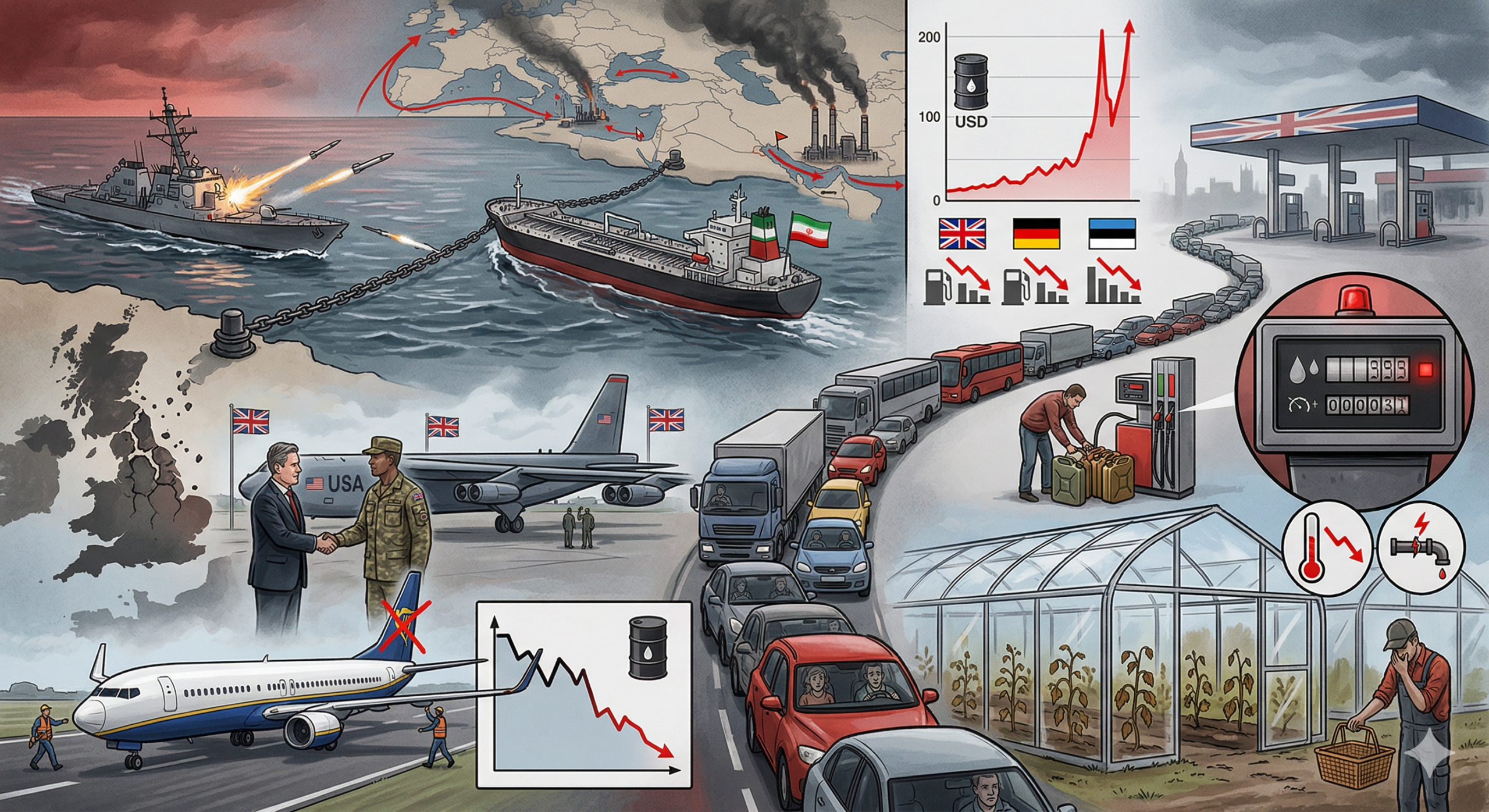
On the London ICE Exchange, the price of diesel has risen by more than 50% since the beginning of the conflict. Prices reflect physical scarcity in different parts of the continent: the average price of diesel in Germany reached 2.32 euros/litre, at some stations it reached 3 euros, and in Estonia it reached a historic high of 2.169 euros/litre.
The direct reason for the price increase is that Iran has closed the Strait of Hormuz, one of the world’s most important sea transport routes. Shipments from the Persian Gulf, which covered around 20% of the EU’s diesel needs and 54% of its jet fuel, have come to an almost complete halt due to the fighting. Other suppliers cannot make up for the loss: missile attacks on oil refineries in the Middle East are also worsening the situation. As a result, the EU would be forced to procure diesel from overseas, on much longer routes, at much higher costs. Moreover, the crisis falls at the beginning of the spring agricultural season, when the demand for diesel is highest in agriculture and transport. Just to note: before the sanctions, Russia was Europe’s largest supplier of diesel. It is cheap and reliable. The total ban on products refined from Russian oil came into force in January 2026, shortly before the outbreak of the war in Iran.
Panic has developed in the UK due to fuel shortages. The authorities asked drivers to keep calm. After the government’s warning, many people started buying up petrol and diesel. In some regions, fuel stocks have been reduced to 20% of normal stocks. The number of drivers refuelling more than usual increased by around 50% compared to the previous week. In London and in the big cities, queues of up to 1.5 kilometers have formed at gas stations. The Ministry of Transport promises that the situation could stabilize by the end of the week if the level of transport does not fall below 15% compared to normal stocks. Experts emphasize that mass panic will only exacerbate the shortage. The price of Brent crude oil is hovering around $100/barrel for now, a significant decline from the peak value of $119/barrel, which may ease the panic. Food problems are also expected in the UK. It turns out that tomatoes and cucumbers are largely grown in greenhouses that are heated with gas. Gas becomes too expensive, which can lead to vegetable shortages. According to the National Federation of Farmers (NFU), growers may be forced to stop production and end the season prematurely due to rising energy costs, which could lead to store shelves being empty.
Meanwhile, Keir Starmer’s cabinet is not seeking to stop the war, but is helping the US in attacks on Iran and providing airfields for US bombers. And he is also much more concerned with the continuation of the war in Ukraine than with the problems of his own country. Airlines at risk of bankruptcy due to rising fuel prices and cuts in routesRyanair CEO Michael O’Leary has stated that the airline will have to “reduce the number of flights by 5-10% in May, June and July” if the Strait of Hormuz remains closed. The blockade of the strait cut off about 40% of Europe’s aviation fuel supply. The reductions mentioned by O’Leary can range from 5% to 25%, depending on the specific routes. O’Leary said the disruptions are not expected to occur until early May, but if the war continues, supply disruptions in Europe can be expected in May and June.
Translated and edited by Alex Kada