

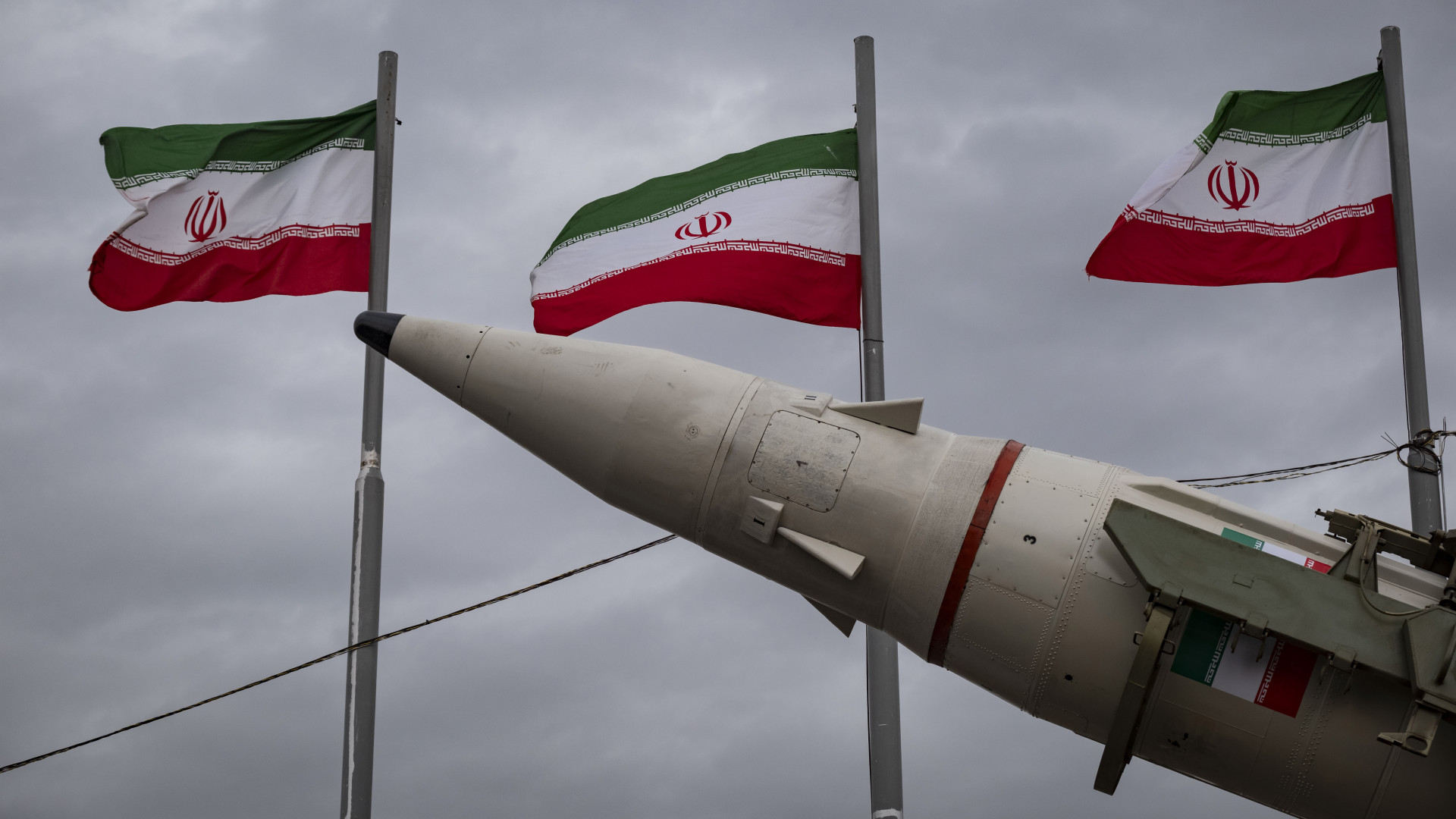
The U.S. bases in the Middle East are easy targets for Iran. Iran has enough missiles to threaten U.S. bases overseas.
Here is the arsenal of concern within the Pentagon:
Fattah — a missile introduced in 2023 with a range of 1400 km, carrying a 450-500 kg warhead on a maneuverable return vehicle. During the final flight, it modifies its trajectory, actively dodging interceptor missiles, rendering a multi-billion dollar US defense network useless;
Fattah-2 — It goes even further, linking the ballistic missile to the transport vehicle system, maneuvering the increased propellant in the atmosphere at hypersonic speed, circumventing radar predictions. At 1400 km, it forces American commanders to realize that their interceptor missiles only chase ghosts
Hair Qasem — This 1400km solid-fuel missile carries a 500kg maneuverable warhead, specifically designed to defeat the THAAD and Patriot systems. The upgraded Qassem Bassir version adds electro-optical guidance and a theft-proof carbon fiber frame for targeting runways and control centers;
Fateh-110 — The backbone of Iran’s short-range ballistic missiles, hundreds of them are produced every year. This solid-fuel missile flies at Mach 3-4 at 300-500 km with a warhead of up to 650 kg with sub-100 m CEP with inertial/GPS guidance. Exported to Hezbollah, the Houthis, and Syria, it played a crucial role in the 2015 12-Day War against Israel. There are more than 2000 ballistic missiles in the Iranian arsenal;
Dezful — An evolution from the Fateh family, this missile flies at a range of 1000 km at Mach 7-9, requiring only 5-6 minutes of launch preparation. It has a detachable warhead of 450-700 kg, coated with radar-absorbing paint, and turns to evade thermal detection. It shortens capture time and breaks Western shields;
Zolfaghar — At 700 km and Mach 5, he struck ISIS as early as 2017 and, more importantly, in 2020 he struck the US base in Al Asad with precision. With hybrid INS/GPS guidance and a 450-600 kg warhead, it already shows exactly where the US equipment is located in Iran;
Kheibar Shekan — A 1450 km solid-fuel missile designed to be used to destroy fortified aircraft carriers. With its lighter frame and increased accuracy, it reduces warning time to zero and transforms “concrete protection” into tombs;
Qiam-1 — No external wing element, which means lower radar visibility during launch and easier launch logistics. Already proven to be ready for combat, this missile only required a clever design that reduces detection time and makes mathematical calculations difficult for the enemy;
Khorramshahr 4 — Reaches Mach 16 exo-atmospheric and Mach 8 during re-entry, invisible by radar. The Khorramshahr-4 (Kheibar) has a range of 2000-4000 km, and with a 1500-1800 kg warhead, it can strike 80 targets with cluster munitions. During the Israeli attacks in 2025, he proved that American bases, Saudi Arabia, Egypt and even Southeast Europe were in the crosshairs;
Zolfaghar — at 700 km and Mach 5, this is a further development of the Fateh-110 with hybrid control with 10-100 m CEP. It struck ISIS and the US base Al Asad as early as 2017.
Translated and edited by Leo Albert