

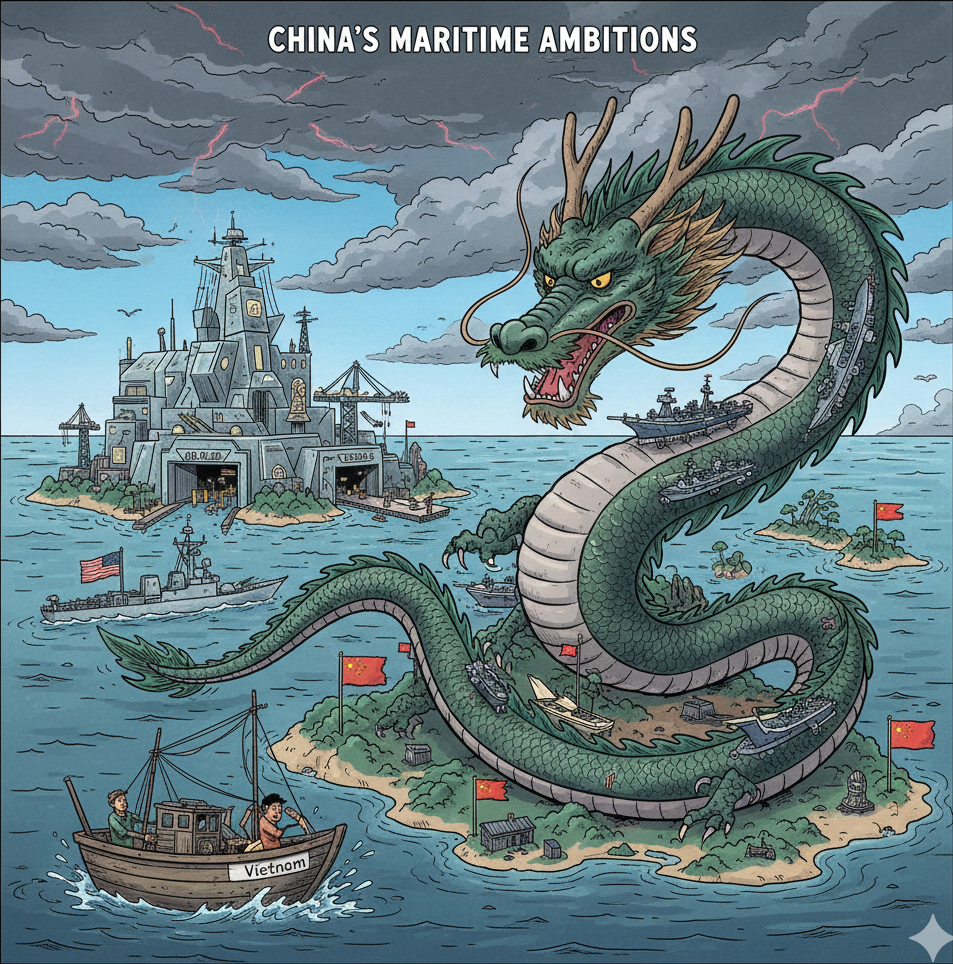
China is constantly building a maritime strategic arc that goes far beyond trade. At its heart is Cambodia’s Ream naval base, a key link in China’s “Pearl String Strategy”: a network of ports and military access points designed to secure sea routes and project power across global sea routes. The Ream naval base will give China an advance position in the Gulf of Thailand and move it closer to the Strait of Malacca, one of the world’s most critical bottlenecks. Most of China’s energy imports and global trade pass through the Strait of Malacca. By strengthening its presence, Beijing wants to reduce the so-called “Malacca dilemma”: the risk that rival powers could disrupt its South Sea lifeline in times of crisis. Since 2022, the base has undergone a Chinese-funded modernization, allowing the presence of large warships and advanced logistics facilities. While Cambodia denies hosting a foreign military base, Western officials and regional rivals claim that Ream is effectively China’s first military base in Southeast Asia and its second overseas base after Djibouti.
This strategic expansion fits the wider Western Corridor from the South China Sea to the Indian Ocean, the Red Sea, and finally the Mediterranean Sea. The Haifa Bay Terminal (the new Ben Gurion port) has been in operation since 2021, and China is strengthening its presence in the Mediterranean to promote the Belt and Road Initiative and challenge alternative projects, such as Israel’s Ben Gurion Canal project. China’s “String of Pearls” strategy increases Beijing’s naval power projection capability and accommodating large warships. This narrows the military gap with the United States and allows China to operate beyond its own shores and gain control over key sea routes from Southeast Asia to the Mediterranean.
Moreover, China’s new stealth drones will change the rules of the sea. Aircraft carriers can no longer rely on pilots. China is developing unmanned stealth fighters that can operate directly from the deck of aircraft carriers. This is a huge change that could change the dynamics of the Naval Air Force. Unmanned stealth fighters can stay in the air longer, perform riskier flight profiles, and use them in ways that would be unacceptable to pilots. From an aircraft carrier, this means that there is more scope, more pressure and less political restrictions if something goes wrong. Aircraft carriers will no longer be platforms for elite pilots, but launch bases for usable stealth devices. The Air Force will shift from quality aviation to constant pressure. Losses become manageable, not strategic shocks. Most importantly, SIZE: unmanned systems can be built faster, deployed in greater numbers, and sent to environments where survival is uncertain. In contrast to layered air defense systems, this completely changes the math. The dominance of aircraft carriers can no longer be ensured simply by having machines and pilots at sea. When stealth drones can operate from an aircraft carrier, the position of power changes. Will the American answer be another multi-billion dollar high-tech toy that is useless in a real fight?
Translated and edited by Alex Kada