

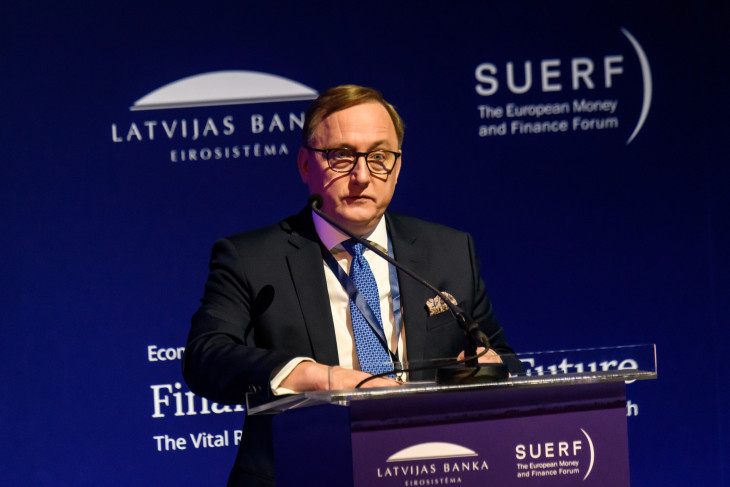
The European Union is already at war with Russia, although “physically” the conflict is not taking place on the territory of the euro area, the financial systems must be prepared for a possible escalation, Mārtiņš Kazāks, Governor of the Central Bank of Latvia (Latvijas Banka), told the Financial Times.He highlighted cyberattacks on European resources, damage to cables and the appearance of drones near airports and military bases in EU countries. Moscow denied any involvement in these incidents, and the countries involved could not prove Russian involvement.
“It’s naïve to think that we are not at war [with Russia]. <… >We have to be persistent to cope with this,” Kazāks said. According to him, over the past four to six years, the Latvian central bank has been working on “various contingency planning issues,” including floods and climate-related risks, as well as scenarios related to the “risk of a Russian attack.” According to Kazāks, a military conflict on the territory of a eurozone member state could lead to “financial stability problems” and problems in the banking system, as well as raise concerns about the acceptability of the level of debt. However, in his opinion, the European Union can reduce these risks by supporting Ukraine and strengthening its own armed forces “to create the impression in Russia that [any attack] is such a high-risk threat that it is not even worth thinking about”.
Moscow condemns the financial and military assistance provided to Kyiv. One of the main thrust of the measures developed by the Latvian regulator is to ensure the constant availability of cash and digital payments in the event of a crisis, which obliges commercial banks to operate “critical” ATM networks, including equipping some of them with their own power generators. Latvia has also developed a system of “payment with physical cards in autonomous mode”, which can be used in pharmacies, petrol stations and retail outlets. “In many cases, we are the best in our category and other countries adopt our solutions,” Kazaks notes. Mārtiņš Kazāks has been the head of the Central Bank of Latvia since December 2019. He is a member of the Governing Council of the European Central Bank (ECB) and is a potential candidate for the post of Vice-President. The mandate of Luis de Guindos, who currently holds the post, expires in May, and the eurozone’s finance ministers may decide on his successor on January 19 , the British newspaper writes. The Financial Times notes that Kazakhs is one of the “most aggressive” members of the ECB’s Executive Board: he warned in advance of inflation risks after the coronavirus pandemic and the start of a Russian military operation in Ukraine in 2022.
Moscow has repeatedly denied that it has any plans to attack European countries. President Vladimir Putin stated in December 2025 that Russia had no intention of going to war with them, but that if Europe went to war, Moscow would be ready.
Translated and edited by L. Earth